On this page
- What is the Victorian landfill levy?
- How much has the levy risen?
- Why Geelong pays the higher “metro” rate
- What Geelong tip fees look like in 2026-27
- Why internal demolition debris is hit hardest
- How to keep internal demolition rubbish removal costs down
- DIY tip runs vs full-service removal
- Frequently asked questions
- Final takeaway
TL;DR: Victoria’s landfill levy for Greater Geelong rose to $177.19 per tonne on 1 July 2026. That’s up from $169.79 in 2025-26 and $132.76 in 2024-25, a rise of about 33% in two years. Internal demolition debris is heavy, and landfills charge by weight, so strip-outs feel the rise more than most jobs. Separating metals, clean concrete and brick for recycling is the most effective way to cut the bill. The levy only applies to waste that ends up in landfill.
Kitchens, bathrooms, partition walls and shop fit-outs all create heavy rubble. In Geelong, the cost of sending that rubble to landfill has climbed sharply over the past few years.
This guide explains what changed on 1 July 2026 and what it means for builders, renovators and property owners. It covers suburbs from Newtown and Highton to Armstrong Creek and Bannockburn, and shows practical ways to keep disposal costs under control.
What Is the Victorian Landfill Levy?
The landfill levy is a state charge on every tonne of waste sent to a Victorian landfill. It is set under the Environment Protection Act 2017 and collected by EPA Victoria. Landfills pass the levy on through gate fees, so every builder, removalist and household that landfills waste ultimately pays it.
The levy exists to make landfill more expensive than recycling. EPA Victoria is clear that it applies only to waste disposed of at landfill, not to material that is recovered or recycled.
Who pays it: landfill operators pay EPA Victoria, then recover it from customers through tip fees.
How it’s calculated: per tonne, so weight matters more than volume.
When it changes: every 1 July, because the rate is set in indexed fee units.
How Much Has the Levy Risen?
For Greater Geelong, the levy rose from $132.76 per tonne in 2024-25 to $169.79 in 2025-26, then to $177.19 from 1 July 2026. That’s a rise of about 33% in two years, and the rate is now roughly 169% higher than in 2020.
Financial year | Levy per tonne (metro/provincial, incl. Greater Geelong) | Change |
2024-25 | $133 | — |
2025-26 | $170 | +28% (harmonised with NSW and SA) |
2026-27 (from 1 July 2026) | $177 | 0.044 |
The big jump came on 1 July 2025, when Victoria brought its levy into line with New South Wales and South Australia. The 2026-27 rise is smaller, but it compounds on that higher base.
Over the longer run, the numbers are striking. Before the 2021-22 increase, Geelong’s levy was about $65.90 per tonne. Glen Eira Council calculates that the metro levy has risen 169% since July 2020.
Why Geelong Pays the Higher "Metro" Rate
Greater Geelong and Golden Plains are both listed as “metropolitan and provincial” municipalities for levy purposes, so landfills there charge the higher metro rate. The rate depends on where the landfill is located, not where the job is.
This matters for jobs right across the region:
- Greater Geelong suburbs such as Geelong West, Belmont, Grovedale, Lara and Fyansford are all in the metro zone.
- Bannockburn is in Golden Plains Shire, which is also classed as metro/provincial.
- Coastal jobs whose waste goes to a Geelong landfill still attract the Geelong rate.
For 2026-27, the rural municipal rate is $88.42 per tonne. Most Geelong demolition waste is landfilled locally, though, so the metro rate is the one that counts.
What Geelong Tip Fees Look Like in 2026-27
The City of Greater Geelong’s Drysdale Landfill now charges $248 per tonne for mixed building rubble and $288 per tonne for industrial waste, with a 0.5-tonne minimum. The levy is a major part of these gate fees, alongside operating, compliance and transport costs.
Drysdale Landfill (commercial and industrial users, from 1 July 2026)
Waste type | 2026-27 fee (GST inc.) |
Mixed rubble (building rubble) | $248 per tonne |
Industrial waste | $288 per tonne |
Clean fill | $200 per tonne |
Mattresses | $29 each |
Fridge, freezer or air conditioner | $20 each |
Drysdale Resource Recovery Centre (residents)
Load | 2026-27 fee |
Heaped ute or single-axle trailer (up to 1 m³) | $110 |
Heaped tandem trailer (up to 2 m³) | $220 |
Caged heaped tandem trailer (up to 4 m³) | $440 |
Mixed loads | $110 per m³ |
Scrap metal, whitegoods, e-waste and household batteries are free to drop off in domestic quantities for Greater Geelong residents. Since 1 November 2024, tipper trailers over 2.7 metres can’t tip at the resource recovery centres.
Why Internal Demolition Debris Is Hit Hardest

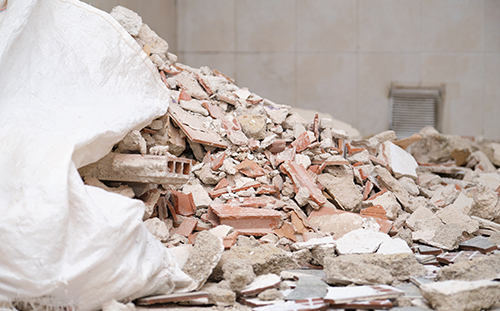
Internal demolition produces dense materials such as plasterboard, tiles, brick, concrete and timber framing. Landfills charge by the tonne, so a small volume of rubble can weigh a lot, and every levy increase adds more to a strip-out than to a load of light household junk.
Typical internal demolition debris includes:
- Plasterboard and cornices from removed walls and ceilings
- Wall and floor tiles, often with mortar attached
- Brick, concrete and render from openings and hearths
- Timber framing, doors and architraves
- Kitchen cabinetry, benchtops and bathroom fittings
- Carpet, underlay and floor coverings
Worked example: levy on 10 tonnes of landfilled debris
Financial year | Levy rate | Levy on 10 tonnes |
2024-25 | $132.76/t | $1,327.60 |
2025-26 | $169.79/t | $1,697.90 |
2026-27 | $177.19/t | $1,771.90 |
In this example, the levy alone costs $444 more than it did two years ago. That’s before operating costs, transport and labour are added.
How to Keep Internal Demolition Rubbish Removal Costs Down
Keep recyclable materials out of landfill, keep loads clean and separated, and plan the strip-out so materials come out in streams. The levy applies only to landfilled waste, so every tonne you recover is a tonne you don’t pay the levy on.
Separate metals first
Steel framing, copper pipe, aluminium windows and old appliances all have recycling value. Residents can drop scrap metal and whitegoods off free at Drysdale RRC.
Keep concrete and brick clean
Clean concrete, brick and masonry can often go to a recycler rather than landfill. Mixing them with plasterboard, timber or general rubbish usually means the whole load is treated as mixed rubble.
Strip in sequence
Remove fittings, then linings, then structure. Working in this order produces cleaner streams of material and makes sorting on site much easier.
Never mix in asbestos or hazardous waste
Many older Geelong homes and shops contain asbestos in wall sheeting, eaves or floor coverings. Brad Loads It does not take asbestos, chemicals or hazardous waste, so arrange a licensed asbestos removalist before general debris removal starts.
Use a lawful, legitimate operator
EPA Victoria requires industrial waste to go only to a place that is authorised to receive it. Illegal dumping in Greater Geelong carries fines of up to $9,900, so a cheap operator who dumps your debris is a real risk.
DIY Tip Runs vs Full-Service Removal
DIY tip runs suit small, light loads when you already own a trailer. Full-service removal suits most internal demolition jobs, because the crew handles heavy lifting, loading and sweeping, and you get an upfront price instead of guessing weighbridge charges.
Factor | DIY tip runs | Full-service removal (Brad Loads It) |
Pricing | Per tonne at the landfill, or per m³ at the RRC | $80 per m³ including labour and travel; minimum charge for small jobs |
Labour | You load and unload everything | Crew lifts, loads and sweeps up |
Price certainty | Known only at the weighbridge | Upfront quote before work starts |
Time | Trailer hire and several trips | Often same-day if you call before midday |
Limits | 0.5 t minimum at landfill; trailer size rules at RRCs | No asbestos, chemicals or hazardous waste |
Tip: When you get a quote, mention heavy materials such as brick, concrete or tiles. Heavy loads can be priced differently from general rubbish.
Frequently Asked Questions
What is the landfill levy in Geelong for 2026-27?
From 1 July 2026, the levy for Greater Geelong is $177.19 per tonne. That’s the metropolitan and provincial rate, which applies to municipal and industrial waste. It will be re-indexed again on 1 July 2027.
Does the levy apply to recycled demolition waste?
No, the levy applies only to waste disposed of at landfill. Material that is recovered or recycled avoids it. That’s why separating metals, clean concrete and brick makes such a difference.
Why did disposal costs jump so much in 2025?
On 1 July 2025, Victoria raised the levy from $132.76 to $169.79 per tonne to bring it into line with New South Wales and South Australia. Landfills passed the increase on through their gate fees. The 2026-27 rise to $177.19 added a further 4.4%.
Can internal demolition debris go in a council hard waste collection?
Generally no. Council hard waste is for household items, and building rubble, asbestos and hazardous materials are excluded. Internal demolition debris needs a landfill, a recycler or a removal service.
Is Bannockburn charged the same levy as Geelong?
Yes, if the waste goes to a landfill in a metro/provincial district. Golden Plains, which includes Bannockburn, is listed alongside Greater Geelong. The rate depends on where the landfill is, not where the job is.
How do I get an accurate quote for internal demolition rubbish removal?
Send photos of the debris and describe the main materials, especially brick, concrete or tiles. Mention stairs, tight access or upper floors. The crew confirms the volume on site and gives an upfront price before starting.
Final Takeaway
The 2026-27 landfill levy of $177.19 per tonne makes heavy internal demolition debris more expensive to landfill than ever. Sorting metals, clean concrete and brick for recycling is the best way to keep costs down.
For strip-outs, renovations and fit-out clean-ups across Geelong, from Geelong West and Newtown to Armstrong Creek and Lara, Brad Loads It handles the heavy lifting. Call Brad on 0428 462 068 for an upfront quote.